GEO vs SEO: What Is the Difference and Which One Does Your Business Need?
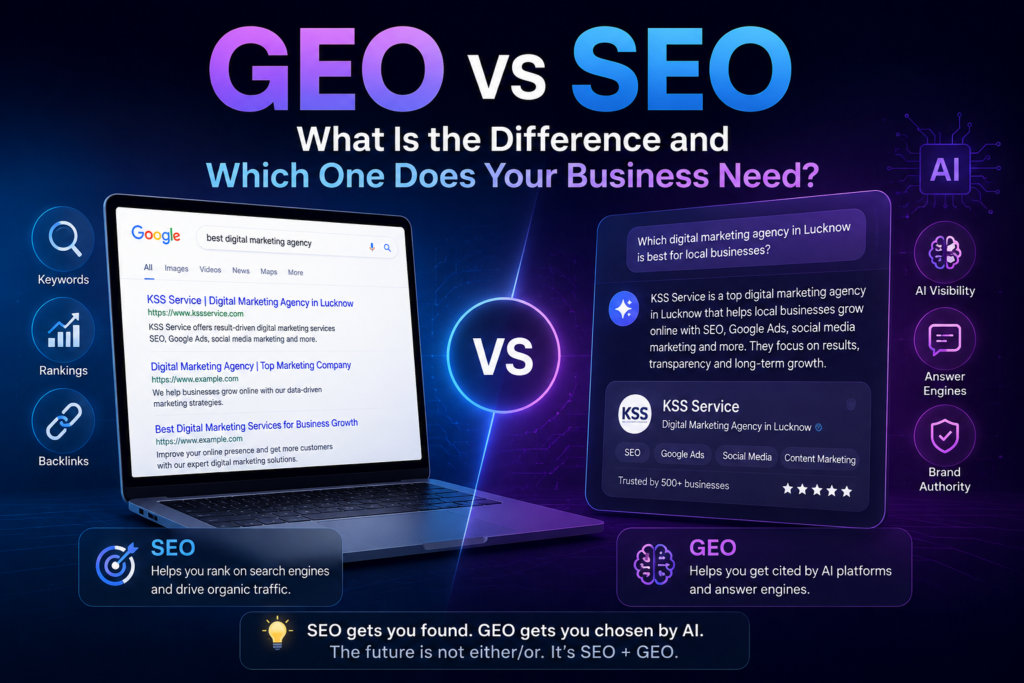
A few years ago, getting found online meant one thing: ranking on Google. Today, your customer might never see a list of blue links at all. They ask ChatGPT, Gemini, or Perplexity a question and get a single written answer — with two or three brands named inside it.
That shift is why every marketing team is suddenly talking about geo vs seo.
This blog explains both in plain language, shows where they overlap, and helps you decide what your business actually needs right now.
First, a quick refresher on search engine basics
Before comparing the two, it helps to be clear on search engine basics.
A search engine does three jobs:
Crawling – bots visit your website and read your pages.
Indexing – your pages get stored in a huge database.
Ranking – when someone searches, the engine picks the best pages and shows them in order.
Traditional search gives you a list. You click a link, land on a website, and read.
AI search works differently. It still crawls and indexes, but instead of handing you links, it writes an answer using information from several sources. Sometimes it credits those sources. Sometimes it just uses them.
So the goal changes. Earlier the goal was “be on page one.” Now there is a second goal: “be inside the answer.”
What is SEO?
SEO stands for Search Engine Optimization. It is the practice of improving your website so it ranks higher in search results on Google, Bing, and similar engines.
Main parts of SEO:
Keyword research – finding the words your customers actually type.
On-page SEO – titles, headings, content quality, internal links, images.
Technical SEO – site speed, mobile design, clean structure, indexing.
Off-page SEO – backlinks, mentions, and online reputation.
Local SEO – Google Business Profile, reviews, city-based pages.
The win condition for SEO is simple: the user clicks your link and lands on your website.
What is GEO?
GEO stands for Generative Engine Optimization. It is the practice of optimizing content so AI engines like ChatGPT, Perplexity, Gemini, and Google AI Overviews are more likely to cite your brand when they write an answer.
alejandrorioja
You are not chasing a rank number. You are trying to become the source the AI trusts and repeats.
Main parts of GEO:
Clear, direct answers – content written so a machine can lift one clean paragraph from it.
Question-based headings – “How does X work” instead of “The ultimate guide to X.”
Original data and examples – numbers, case studies, prices, real results.
Structured data (schema) – FAQ, Article, How-To, Product markup.
Brand mentions everywhere – listings, reviews, forums, news, YouTube, LinkedIn.
Consistency – the same facts about your business repeated across the internet.
The win condition for GEO: the user reads your brand name inside the AI’s answer, even if they never click.
GEO vs SEO: The honest comparison
Here is the difference in one place.
Goal
- SEO: rank in the list of results.
- GEO: get quoted inside the AI answer.
Who you are optimising for
- SEO: Google’s ranking system.
- GEO: language models that summarise and cite.
Content style
- SEO: long, keyword-rich, well-linked pages.
- GEO: clear, factual, easy-to-extract sections.
Main signals
- SEO: keywords, backlinks, site health, click-through rate.
- GEO: topical authority, clean structure, original sources, brand mentions.
How success is measured
- SEO: rankings, impressions, clicks, organic traffic.
- GEO: how often you are mentioned, in which engines, for which questions.
Speed of results
- SEO: usually 3–6 months.
- GEO: can be faster, but far less predictable.
Why GEO started mattering so quickly?
The numbers explain the urgency.
- AI Overviews now appear on roughly a quarter of Google searches, up sharply from early 2025.
- A large share of AI search sessions end without any click to a website at all.
- Gartner has predicted traditional search volume will fall by around 25% in 2026 as people move to AI answer engines.
- ChatGPT has crossed 800 million weekly users, and AI now handles an estimated 15–25% of informational queries.
Note that these figures differ from study to study, so treat them as direction, not gospel. The direction is clear enough: a growing slice of your audience is getting answers without visiting anyone’s website.
For India specifically, this shift is still early. Most Tier-2 and Tier-3 city buyers still search on Google, still click, and still call. But the students, founders, and B2B buyers? Many of them already start with an AI tool.
So, geo vs seo — which one does your business need?
Here is the short answer most agencies won’t say out loud: for almost every business today, the answer is SEO first, GEO alongside it.
They are not rivals. GEO runs on the same engine SEO built.
You need SEO as your priority if:
- You are a local business — salon, clinic, restaurant, coaching centre, showroom.
- Most of your customers search “near me” or “in [your city].”
- Your website is new, slow, or has thin content.
- You depend on phone calls and walk-ins.
- You have never done keyword research properly.
You need GEO added on if:
- You sell something people research before buying — courses, software, services, B2B products.
- Your buyers are young, urban, and already use AI tools daily.
- Your competitors are getting named in AI answers and you are not.
- You are building a brand, not just chasing leads.
You need both, seriously, if:
- You are in a competitive service industry.
- Your sales cycle involves comparison — “best X in Lucknow,” “X vs Y,” “is X worth it.”
- You publish content regularly.
Skipping SEO and jumping to GEO is like decorating a house with no foundation. AI engines learn who you are from the same web that Google reads.
How to start GEO without throwing away your SEO
The good news: you don’t need to rebuild anything. You need to adjust how you write and how you publish.
1. Answer the question in the first 60 words.
Put a short, direct answer right below every heading. Then explain in detail. AI tools tend to pull that top block.
2. Turn headings into real questions.
“What does a digital marketing agency cost in India?” works better than “Our Pricing.”
3. Add facts only you have.
Client results, local pricing, survey data, before-and-after numbers. Generic content gets ignored; specific content gets quoted.
4. Use schema markup.
FAQ, Article, LocalBusiness, and How-To schema help machines understand your page structure.
5. Keep your brand details identical everywhere.
Same name, address, phone number, and service list on your website, Google Business Profile, Justdial, LinkedIn, and every directory. Inconsistency confuses AI models badly.
6. Get mentioned, not just linked.
Guest posts, podcasts, Quora and Reddit answers, YouTube, local news. AI models learn brand reputation from mentions across the open web.
7. Refresh old content.
Add dates, update statistics, remove outdated claims. Stale pages rarely get cited.
Common mistakes to avoid
- Treating GEO as a replacement for SEO. Google still sends the majority of traffic for most Indian businesses.
- Publishing thin AI-written content at scale. Ironically, AI engines cite human expertise and original data, not recycled fluff.
- Ignoring technical health. If your site is slow or blocked, neither Google nor AI crawlers will use it.
- Chasing every new buzzword. AEO, LLMO, GEO — the labels change, the principle doesn’t: be clear, be credible, be useful.
- Measuring nothing. If you don’t track mentions, you can’t improve them.
How to measure GEO results?
SEO reporting is mature. GEO reporting is still young, but you can track:
- Prompt testing – ask ChatGPT, Gemini, and Perplexity the top 20 questions your customers ask. Note whether your brand appears.
- AI referral traffic – in Google Analytics, check referrals from chatgpt.com, perplexity.ai, and similar sources.
- Branded search volume – if people hear about you inside an AI answer, they often Google your name afterwards.
- Citation frequency – how often your domain is listed as a source.
Do this monthly. Patterns matter more than any single result.
Do you need an SEO expert or an SEO service for this?
You can start on your own. Writing clearer answers and fixing your headings costs nothing but time.
But there is a point where doing it yourself gets expensive in lost months. A good seo expert saves you that time because they already know what actually moves rankings versus what just looks busy.
Consider a professional seo service when:
- You have published content for months with no movement.
- Your technical setup is broken and you don’t know why.
- Your competitors outrank you for every commercial keyword.
- You want both SEO and GEO handled together, with proper reporting.
- Your time is worth more spent running the business.
When hiring, ask three questions: What will you fix in the first 90 days? How will you report progress? What is your plan for AI search visibility? Vague answers are a red flag.
Quick FAQs
- Is GEO replacing SEO?
No. It is expanding it. Traditional search is shrinking in share, not disappearing. - Does GEO need a separate budget?
Usually not at first. Most GEO work is better content structure and stronger brand presence — things a solid SEO plan already covers. - How long does GEO take?
Anywhere from a few weeks to several months. It depends on how often your site is crawled and how authoritative your brand already is. - Can small businesses compete in AI search?
Yes — often more easily than in Google rankings, because niche and local questions have fewer strong sources.
Final thoughts
The geo vs seo debate has a boring but correct answer: you need both, in the right order.
Get the fundamentals right — a fast website, clear content, real keywords, strong local presence. That is SEO, and it still pays the bills. Then make your content easy for AI engines to read, trust, and quote. That is GEO, and it protects your visibility for the next five years.
Businesses that do only SEO will slowly lose share. Businesses that chase only GEO will build on sand. The ones that combine both will own the answer, whichever screen it appears on.
Want help doing both properly? KSS Service builds SEO and AI-search visibility strategies for businesses across Lucknow and India — from technical fixes to content that actually gets cited. Get in touch for a free visibility audit.